
If you are comparing the best international schools in Hong Kong in 2026, start with the curriculum and your child’s likely education pathway rather than the school name alone. Hong Kong has 52 international schools on the Education Bureau’s current international-school list, with American, British, Canadian, French, German, Singaporean and International Baccalaureate pathways all represented.
That variety is useful, but it also makes a simple ranking difficult. Hong Kong does not have an official Education Bureau league table naming the number-one international school. A Hong Kong international school ranking therefore needs to be treated as an editorial comparison, not a government-issued score.
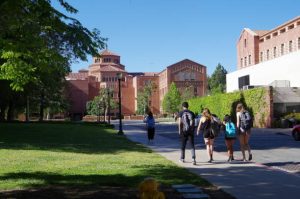
For this 2026 shortlist, I have compared schools using factors that are genuinely useful to families: curriculum continuity, senior qualifications, language provision, breadth of learning opportunities, admissions practicality, published fees, capital funding requirements, age range and the extent to which a school offers a coherent pathway from the early years into secondary education.
I have deliberately avoided creating artificial decimal scores. Saying one school is “96.8” and another is “96.2” suggests a level of precision that school choice simply does not have. The best international schools in Hong Kong are strong for different reasons. A family targeting US universities may reasonably put an American/AP school first, while another family may favour bilingual Mandarin-English education, A Levels or a full IB pathway.
The top 10 international schools in Hong Kong below should therefore be read as a high-priority research list. Before applying, you still need to check whether your child’s year group has places, what language level is expected, how much the full package costs and whether the daily commute is realistic.
2026 Hong Kong International School Ranking: Top 10 International Schools in Hong Kong
This Hong Kong international school ranking focuses on established schools that provide clearly defined international or overseas-curriculum pathways and appear particularly useful for families comparing long-term education options in 2026.
The order reflects overall breadth and practical value rather than one examination result. Curriculum fit should always be allowed to override rank. For example, a child who definitely wants A Levels has little reason to prefer an IB school simply because it appears several places higher on a general list.
| Rank | School | Main Curriculum / Leaving Route | Best Fit |
|---|---|---|---|
| 1 | Hong Kong International School | American curriculum; AP in High School | Families seeking a US-style pathway and extensive AP choice |
| 2 | Chinese International School | Bilingual English-Mandarin curriculum; IB pathway | Families prioritising deep Chinese-English bilingual education |
| 3 | German Swiss International School | English Stream: IGCSE + IB; German Stream: German International Abitur | Families wanting a highly academic dual-stream, multilingual environment |
| 4 | Canadian International School of Hong Kong | IB PYP/MYP/DP + Ontario Secondary School Diploma | Families wanting an IB continuum and dual-diploma senior pathway |
| 5 | Kellett School | English National Curriculum; IGCSE/GCSE + A Levels | Families committed to a British curriculum and A Levels |
| 6 | French International School | International Stream: IGCSE + IB; French Stream: French curriculum | Multilingual families wanting international and French pathway choices |
| 7 | Harrow International School Hong Kong | British curriculum; GCSE/A Level pathway; day and weekly boarding | Families seeking a traditional British-school model with boarding |
| 8 | Singapore International School (Hong Kong) | Singapore curriculum; IGCSE + IB Diploma | Families valuing a structured Singapore academic foundation |
| 9 | Hong Kong Academy | IB PYP/MYP/DP and HKA graduation pathways | Families wanting a smaller, personalised IB environment |
| 10 | Nord Anglia International School Hong Kong | English National Curriculum; IGCSE + IB Diploma | Families seeking a British-to-IB route within a global school network |
Source note: School type and curriculum information were cross-checked against current Education Bureau school profiles and current school information. The ranking itself is an independent 2026 editorial comparison and is not an official Education Bureau ranking.
1. Hong Kong International School
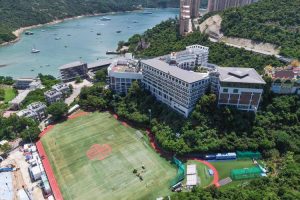
Hong Kong International School, usually shortened to HKIS, is my first pick for families specifically looking for an American education from the early years through Grade 12.
The school operates primary facilities in Repulse Bay and secondary facilities in Tai Tam. Its curriculum is built around American frameworks, and High School students have access to 25 Advanced Placement courses. That makes the pathway especially easy to understand if your family is transferring from the US system or expects university applications to be heavily US-focused.
The scale of HKIS is another distinction. The whole school serves more than 3,000 students, so this is very different from choosing a small international school where each year group has only one or two classes. A larger school can support a broad range of courses and co-curricular activities, but families who actively want a small-school environment should take that difference seriously.
For 2026/27, annual tuition is HK$231,600 for Reception 1 through Grade 5, HK$244,500 for Grades 6–8 and HK$272,600 for Grades 9–12. The annual capital levy is another HK$24,500. New students also face a one-off HK$15,000 entry fee, while the application fee is HK$2,000.
Admissions should not be treated as automatic simply because you submit an application. Selected applicants are invited for pre-entry assessment, with invitations influenced by applicant priority, application volume and expected space in the relevant grade.
Among the top international schools in Hong Kong, HKIS therefore makes most sense if you value the American pathway strongly enough to justify both the cost and the Southside commute.
2. Chinese International School
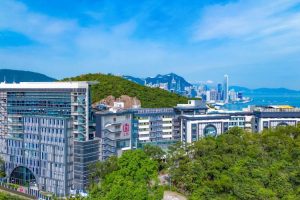
Chinese International School is one of the most distinctive choices on this list because bilingual education is not simply an additional language class added to an English-medium programme.
In Primary, English and Mandarin Chinese both play central roles in teaching. Each homeroom has two teachers representing the two principal languages. That structure makes CIS particularly attractive to families who want their child to develop academically in both languages rather than learn Mandarin mainly as a foreign-language subject.
The school’s international curriculum evolves as pupils move through Secondary. Its programme includes an IB route leading to the IB Diploma in Years 12–13, while Mandarin remains a required subject at Secondary level with different levels available.
Admissions are selective and year-specific. Reception has 96 openings, while the larger Secondary section allows approximately 50 new places in Year 7. For Years 7–13, the current admission process includes a substantial written assessment lasting around three hours and an oral interview of approximately 15 minutes. Suitable candidates can receive offers on a rolling basis after assessment sessions.
The cost structure deserves as much attention as the curriculum. The current Education Bureau profile lists annual tuition in a range of HK$216,100 to HK$342,800, depending on level. Students joining CIS from the applicable intake pay an annual capital levy of HK$30,200. A newly admitted family is also asked to pay a HK$150,000 reservation deposit when accepting a place, with the relevant balance subsequently offset against fees under the school’s payment arrangements.
If your main priority is sustained Mandarin-English bilingual learning rather than simply an English-medium international school with Chinese lessons, CIS deserves to sit very high on your shortlist.
3. German Swiss International School
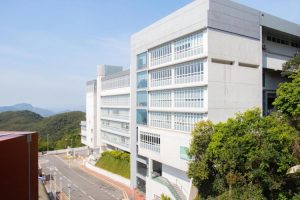
German Swiss International School stands out because it effectively gives families two international education pathways within one school.
The English International Stream follows an English-medium route leading through IGCSE and then the IB Diploma. The German International Stream follows a German pathway culminating in the German International Abitur. GSIS therefore offers more curricular choice than its name might initially suggest.
The school educates children from around age 3 to 18 and has approximately 1,380 students representing 27 nationalities. Languages taught include German, English, Mandarin, French and Latin.
That multilingual environment is an important point when comparing the top 10 international schools in Hong Kong. For some families, the ability to maintain a German education pathway is the deciding factor. For others, the attraction is the English Stream combined with the wider language environment and long-established school community.
The Education Bureau profile for the English Stream lists annual fees from approximately HK$203,700 to HK$256,700, depending on year level. Families should still confirm the precise current fee, registration and capital arrangements for the relevant stream before accepting a place.
GSIS is particularly worth considering if your family values strong academics but does not want to choose between a globally recognised English-language route and a German-system option at the initial school-search stage.
4. Canadian International School of Hong Kong
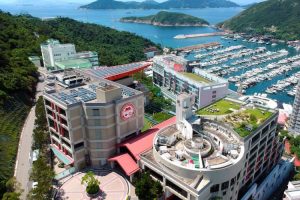
Canadian International School of Hong Kong offers one of the clearest dual-qualification propositions among the best international schools in Hong Kong.
CDNIS is an IB continuum school offering the Primary Years Programme, Middle Years Programme and Diploma Programme. In Grades 9–12, students also work towards the Ontario Secondary School Diploma. Graduates can therefore complete both the IB Diploma and OSSD rather than relying on a single leaving qualification.
The Lower School is also moving further into bilingual education. CDNIS has been progressively extending its English-Chinese bilingual model, with Grade 3 joining the bilingual programme in 2026/27. The model uses both languages as media of instruction rather than limiting Chinese to isolated language lessons.
For 2026/27, fees vary considerably by age. Nursery is HK$142,780. Preparatory to Grade 2 is HK$217,200, Grades 6–8 cost HK$223,100, Grades 9–10 HK$244,800 and Grades 11–12 HK$261,500.
For students entering EY1 and above, the annual capital levy is HK$43,000 unless the student is appropriately covered by a debenture. New students in those year groups also pay a HK$12,500 entry fee. The current application fee is HK$2,350 and the assessment fee is HK$1,650.
The school also makes an important distinction around debentures: holding or applying for a debenture does not guarantee admission. Candidates still need to satisfy the school’s entry criteria.
CDNIS is a particularly strong shortlist choice if you want the IB philosophy but also value a recognised Canadian secondary credential and a growing bilingual pathway.
5. Kellett School
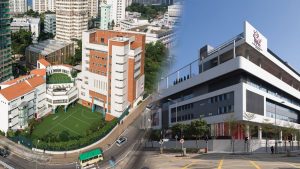
Kellett is one of the most straightforward choices for a family that wants to preserve a British education route in Hong Kong.
The curriculum is based on the English National Curriculum. Students progress towards GCSE and International GCSE examinations in Year 11 before moving into A Levels in Years 12–13.
That last point is important. Many international schools in Hong Kong finish with the IB Diploma. Kellett remains one of the relatively limited choices for families who specifically want A Levels.
For 2026/27, provisional annual tuition is HK$218,200 for Reception to Year 6, HK$271,300 for Years 7–11 and HK$279,100 for Years 12–13, subject to the relevant approval process.
Every student also needs to be covered by either a debenture or an Annual Capital Levy. Families therefore should not compare Kellett’s tuition figure with an IB school’s tuition figure and assume the difference represents the full cost difference.
The application fee is HK$2,000 for Reception through Year 4. For Year 5 through Year 13 it is HK$2,500, which includes the assessment fee.
Kellett operates a Preparatory campus in Pok Fu Lam and a Preparatory plus Senior campus in Kowloon Bay. Location therefore needs careful thought, particularly if siblings will be in different sections.
If your likely long-term plan involves GCSEs followed by A Levels and possibly university in the UK, Kellett may deserve a higher personal rank than several schools above it in this general Hong Kong international school ranking.
6. French International School
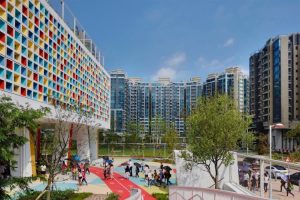
French International School is useful even for families who are not looking for a French-only education, because FIS operates both French and International streams.
In the International Stream, students move towards IGCSE during Years 7–11 and the IB Diploma in Years 12–13. The French Stream follows the French educational pathway and also offers several bilingual or international options.
This gives FIS a particularly interesting position among the top international schools in HK. A multilingual family can consider one school while comparing distinctly different academic routes.
For 2026/27, International Stream annual tuition is HK$156,729 for Nursery and Reception, HK$166,408 for Years 1–6, HK$208,302 for Years 7–11 and HK$224,298 for Years 12–13 before the published grant is applied.
The school also publishes a HK$2,200 application fee and HK$1,000 assessment fee. Students must be covered by a debenture: the published private debenture is HK$120,000, while the corporate option is HK$250,000. A HK$5,000 debenture administration fee also applies.
These capital arrangements illustrate why international-school comparisons should never show tuition alone.
FIS can be a very practical option if your child is likely to benefit from a multilingual environment, if your family may move between European and international systems, or if you want an IGCSE-to-IB route without giving up access to a strongly French international community.
7. Harrow International School Hong Kong
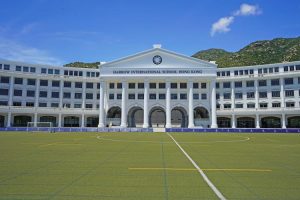
Harrow International School Hong Kong provides a different experience from most other schools in this top 10 because boarding is part of the model.
The school is located in Tuen Mun and follows a British curriculum. Its pathway leads towards GCSEs and A Levels. Boarding is available from Year 6 and operates on a weekly basis rather than requiring every child to live permanently at school.
That structure can make Harrow unusually attractive to certain families. A child living far from Tuen Mun may be able to avoid a punishing daily commute through weekly boarding, while another family may specifically value the House system and wider British boarding-school culture.
The Education Bureau profile identifies interview and assessment as part of admissions and lists priority considerations including debentures, staff children, siblings, boarding and overseas applicants.
One point needs particular caution in a 2026 comparison: at the time this guide was checked, the school’s official fee page had not yet published a separate 2026/27 tuition schedule. I would therefore not fill that gap with an assumed number or quietly relabel an older fee as current.
If Harrow reaches your final shortlist, ask the admissions team for the current 2026 fee schedule, capital levy or debenture terms and boarding charges before comparing it with the other schools.
Harrow’s location also needs a real-world commute test. A prestigious school can still be the wrong family choice if the daily journey is unsustainable and boarding is not something your child wants.
8. Singapore International School (Hong Kong)
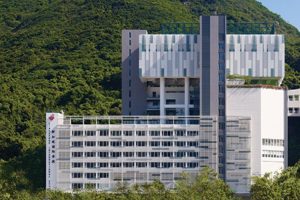
Singapore International School (Hong Kong) offers a particularly clear academic sequence for families attracted to the Singapore education model.
Students follow the Singapore curriculum through Primary and the earlier Secondary years, move into IGCSE in Secondary 3–4, and can then continue into the International Baccalaureate Diploma Programme.
This combination gives parents a structured, subject-focused foundation while still allowing students to graduate with an internationally recognised pre-university qualification.
The Preparatory and Primary campus is in Aberdeen, while the Secondary campus is in Wong Chuk Hang. For families living on Hong Kong Island’s Southside, that can be a significant practical advantage.
For 2026/27, annual fees are HK$106,100 for Preparatory Years, HK$166,000 for Primary 1–6, HK$217,200 for Secondary 1–4 and HK$265,000 for the two IB Diploma years.
Singapore citizens in Primary, Secondary and IBDP who meet the school’s conditions are eligible for the published annual fee subsidy of HK$16,100.
Parents should also understand the age placement system. The school publishes specific birth-year mapping for each academic year, so do not assume that a child transfers into the same numbered grade simply because they are currently in a particular year in another system.
SISHK is particularly appropriate when your family genuinely wants the Singapore-style academic foundation. If you simply want “an international school”, the curriculum difference deserves more attention before applying.
9. Hong Kong Academy
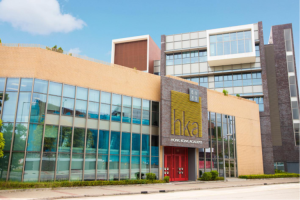
Hong Kong Academy is one of the most interesting alternatives to Hong Kong’s very large, high-profile international schools.
HKA is a non-profit international school in Sai Kung offering the IB Primary Years, Middle Years and Diploma Programmes. The Education Bureau profile describes a community of more than 500 students from over 40 nationalities, making the overall scale more intimate than schools serving several thousand pupils.
The school places considerable emphasis on personalised learning and learning support. Its current profile also highlights more than 100 co-curricular options, alongside science, design, arts and sports facilities.
For 2026/27, annual tuition is HK$119,000 for Pre-K1–Pre-K2, HK$229,500 from Kindergarten to Grade 5, HK$252,600 for Grades 6–8, HK$263,300 for Grades 9–10 and HK$273,900 for Grades 11–12.
A family debenture costs HK$630,000 and exempts one student from the annual capital levy. Families without that coverage pay HK$32,000 per student per year. The first child admitted to the school also has a HK$25,000 entrance fee, and the tuition deposit is HK$30,000.
Admissions availability is a real consideration. The school stated in 2026 that spaces for the current academic year were very limited and recommended contacting admissions before opening an application because the application fee is non-refundable.
HKA deserves particular attention if your child would benefit from an IB continuum but you prefer a smaller school community and Sai Kung is practical for your family.
10. Nord Anglia International School Hong Kong
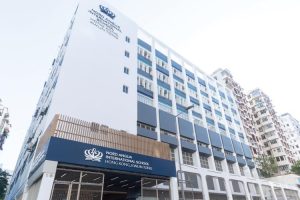
Nord Anglia International School Hong Kong combines a British foundation with an IB senior pathway.
Students follow English National Curriculum frameworks through the earlier stages, progress to IGCSE, and can then take the IB Diploma in Years 12–13. The school also draws on the wider Nord Anglia network and educational collaborations with organisations including MIT and Juilliard.
The main primary and secondary provision is based in Kowloon, including Lam Tin and Kwun Tong, while younger-year arrangements also include Sai Kung provision.
For 2026/27, annual tuition for Years 1–6 is HK$206,700, Years 7–11 is HK$231,300 and Years 12–13 is HK$237,200. Kindergarten and Nursery fees use different session-based amounts.
A HK$35,000 Annual Capital Levy applies to new students admitted from 2026/27. The school also states that it receives more applications than available places and advises families to check availability, particularly before paying a non-refundable application fee. Applications can continue on a rolling basis where places remain.
Admissions assessment depends on the child’s age and year group. Existing siblings receive priority in the relevant early-year assessment process.
NAIS is a sensible choice if you want the familiar structure of British education in the middle years but prefer IB rather than A Levels at Sixth Form.
| School | 2026/27 Annual Tuition | Major Capital / Entry Cost | Planning Note |
|---|---|---|---|
| Hong Kong International School | HK$231,600–272,600 | HK$24,500 annual capital levy; HK$15,000 one-time entry fee | Application fee HK$2,000; transport, devices and some programmes are additional. |
| Chinese International School | EDB profile lists HK$216,100–342,800 | HK$30,200 annual capital levy; HK$150,000 reservation deposit | Check the current grade-specific tuition schedule before accepting an offer. |
| German Swiss International School | EDB profile lists HK$203,700–256,700 | Additional registration/capital arrangements may apply | Confirm costs for the specific German or English Stream. |
| Canadian International School | HK$142,780–261,500 | EY1+: HK$43,000 annual capital levy or qualifying debenture; HK$12,500 entry fee | Nursery has a different capital arrangement. |
| Kellett School | HK$218,200–279,100 provisional | Debenture or Annual Capital Levy required | Check capital funding arrangements alongside tuition. |
| French International School International Stream | HK$156,729–224,298 | HK$120,000 private or HK$250,000 corporate debenture; HK$5,000 admin fee | Published grant reduces the net tuition amount. |
| Singapore International School | HK$106,100–265,000 | Additional enrolment/capital arrangements apply | Eligible Singapore citizens receive a published HK$16,100 annual subsidy. |
| Harrow International School Hong Kong | 2026/27 schedule not published on the official fee page when checked | Capital levy/debenture arrangements apply | Boarding is separate; obtain the current quotation directly. |
| Hong Kong Academy | HK$119,000–273,900 | HK$630,000 family debenture or HK$32,000 annual levy; HK$25,000 first-child entrance fee | HK$30,000 tuition deposit is credited towards tuition. |
| Nord Anglia International School Hong Kong | Years 1–13: HK$206,700–237,200 | HK$35,000 Annual Capital Levy for new students | Nursery and Kindergarten use separate fee bands. |
Source note: Current 2026/27 school fee pages and Education Bureau school profiles. Some fees remain subject to Education Bureau approval. Tuition generally does not represent the complete cost of attendance; transport, meals, uniforms, trips, devices, examinations and optional activities may be charged separately.
How to Shortlist the Best International Schools in Hong Kong
A ranking can reduce 52 international schools to ten names, but ten schools are still far too many for a serious application plan.
The next step is to turn the top international schools in Hong Kong into a shortlist of perhaps three to five realistic choices. I suggest doing this in a fixed order rather than choosing emotionally and then trying to justify the choice afterwards.
Start with curriculum. This is the strongest filter because it can affect several years of education.
If you know that your child is likely to follow a US university pathway and already works comfortably within an American system, HKIS may make sense. If your family wants A Levels, Kellett or Harrow immediately becomes more relevant. If you want an IB continuum from the primary years, CDNIS or HKA deserves greater attention. If Mandarin-English bilingual education is central to the decision, CIS needs to be evaluated differently from an English-medium school offering Mandarin as one subject.
Do not assume that changing curriculum later is effortless.
A student moving from IGCSE to IB, from a Singapore curriculum into an American high school, or from an IB MYP school into an A Level pathway can certainly succeed. But subject sequencing, assessment style, language expectations and year placement may change.
Next, calculate the real budget.
Parents often compare tuition and overlook the larger first-year cash requirement. At one school, tuition may be the dominant expense. At another, you may need an annual capital levy, entry fee, deposit or debenture before the child starts.
A HK$20,000 difference in tuition may be less important than a HK$600,000 debenture requirement. Likewise, a refundable debenture is financially different from a non-refundable annual levy even if both require cash up front.
For every shortlisted school, build a simple first-year and recurring-year budget including:
- tuition;
- application and assessment fees;
- entry or enrolment fee;
- capital levy;
- debenture where applicable;
- school bus;
- lunch;
- uniform;
- laptop or tablet requirements;
- examination fees;
- compulsory or strongly encouraged trips; and
- regular extracurricular costs.
For expatriate families receiving an education allowance, check exactly which of those categories your employer reimburses. A package that covers tuition but excludes capital levies and debentures can still leave a substantial personal bill.
Third, test the commute before applying.
Hong Kong looks compact on a map, but morning school travel can change the practical meaning of “nearby”.
A child travelling 50 minutes each way spends around 100 minutes per school day in transit. Over five school days, that is more than eight hours. Add after-school activities and the journey home can become even longer.
This particularly matters when comparing Southside schools such as HKIS, CIS-adjacent Hong Kong Island options, Kowloon schools such as Kellett and NAIS, and schools further into the New Territories such as Harrow or HKA.
Before paying several non-refundable application fees, test the route at approximately the time your child would actually travel.
Fourth, investigate admissions probability.
A school appearing in the top 10 international schools in Hong Kong does not mean every year group has a seat.
Ask admissions:
- Is the target year currently accepting applications?
- Are there known vacancies?
- Is the year group operating a wait pool?
- Who receives priority?
- Are siblings prioritised?
- Does holding a debenture change priority?
- Will every applicant be assessed?
- What language standard is required?
- When will you know whether an assessment is offered?
- Is the application fee refundable if no assessment takes place?
This last point matters because several top international schools in HK receive more applications than available places. An application is not the same as an assessment, and an assessment is not the same as admission.
At HKIS, selected applicants move to pre-entry assessment with priority and expected availability considered. CIS has its own assessment structure and rolling offers. NAIS explicitly advises families to check availability because application fees are non-refundable. HKA was already reporting very limited spaces for the current academic year during 2026.
A realistic school ranked number eight is more useful than a number-one choice for which your child has almost no chance of receiving an assessment.
Fifth, examine language at classroom level.
The word “bilingual” can mean very different things.
Ask which subjects are taught in each language. Find out how many hours your child actually spends learning through Mandarin, rather than merely learning Mandarin. Ask whether there are different language tracks for native and non-native speakers and whether late-entry students can access suitable support.
CIS’s bilingual structure is fundamentally different from a school where almost every subject is taught in English and Chinese appears mainly as a language subject. CDNIS’s expanding bilingual model is different again.
For a child transferring at age 12 or 13, the language-entry requirement can be more important than the school’s overall reputation.
Sixth, look at your child rather than the ranking.
School selectivity does not prove school fit.
A highly independent student may flourish in an inquiry-heavy IB environment. Another child may perform better with more structured subject teaching. One student loves a large campus with hundreds of classmates and extensive sports teams. Another is more confident in a smaller community.
If your child requires learning support, ask detailed questions before applying:
- What level of learning needs can the school support?
- Is support included in tuition?
- Are additional specialist fees charged?
- How large is the learning-support team?
- Can English-language learners receive additional support?
- Does admission depend on the school deciding it can meet the child’s needs?
The Education Bureau profiles can help you identify schools that report SEN or learning-support provision, but the school’s admissions and support teams should confirm what is actually available for your child.
Seventh, work backwards from the senior qualification.
Parents choosing a Reception or Primary place sometimes focus so heavily on the first year that they ignore what happens at age 16–18.
Ask what the school eventually leads to:
- AP courses and an American High School Diploma;
- IB Diploma;
- A Levels;
- IGCSE followed by IB;
- IGCSE followed by A Levels;
- IB plus Ontario Secondary School Diploma;
- French Baccalauréat; or
- German International Abitur.
This does not mean a five-year-old must decide their university destination now. It simply prevents you from discovering much later that the school’s senior pathway is fundamentally different from what your family expected.
| Criterion | Question to Ask | Common Mistake | Practical Action |
|---|---|---|---|
| Curriculum | Do you want IB, AP/American, A Levels/British, Singapore or another pathway? | Choosing reputation first and curriculum second | Remove schools whose senior qualification does not fit your likely pathway. |
| Budget | What is the true recurring and first-year cost? | Comparing tuition only | Add levies, debentures, entry fees, transport, trips and devices. |
| Commute | Can your child manage the journey twice a day for several years? | Accepting a long journey because the school ranks higher | Test the route during school-morning traffic. |
| Admissions | Is the target year open, waitlisted or priority-based? | Assuming an application fee guarantees assessment | Contact admissions before paying if availability is unclear. |
| Language | How much instruction actually takes place in each language? | Relying on the word “bilingual” | Check subject-level language delivery and entry requirements. |
| Child Fit | Does the learning environment suit your child’s pace and support needs? | Treating selectivity as proof of fit | Visit the school and ask detailed learning-support questions. |
| Senior Pathway | Which qualification will your child take at age 16–18? | Assuming all international schools lead to the same route | Map the IGCSE, IB, AP, A Level or other transition before enrolling. |
| Family Logistics | Can the school work for siblings, work locations and relocation plans? | Shortlisting each child in isolation | Model the whole family’s weekly timetable before accepting an offer. |
Source note: This is an independent decision framework developed from the current admissions, curriculum and fee structures of leading Hong Kong international schools.
Once you have completed these checks, your personal list may look very different from the published Hong Kong international school ranking.
That is a good outcome.
For example, a family living in Kowloon with a child who wants A Levels may place Kellett first even though HKIS is number one in the general ranking. A bilingual Hong Kong family may put CIS first. A Singaporean family relocating to Wong Chuk Hang may find SISHK provides the smoothest academic transition. A family living in Sai Kung with a child who thrives in a smaller IB community may prefer HKA.
This is also why I would avoid asking only, “Which are the top international schools in Hong Kong?” A more productive question is:
“Which of the top international schools in Hong Kong is realistically the best match for my child’s curriculum, language profile, budget, location and next educational step?”
Finally, verify the school information again when you are ready to apply. Tuition can be reviewed annually. Capital arrangements change. Popular year groups fill. Admissions procedures may also be adjusted between cycles.
The best international schools in Hong Kong are not simply the schools with the strongest names. For your family, the strongest choice is the one that combines a credible academic pathway with a realistic admission route, sustainable costs and an environment in which your child can actually thrive.
References
- Hong Kong Education Bureau — International Schools in Hong Kong. Official directory covering the current international-school sector, school types, curricula, age ranges and individual school profiles. https://internationalschools.edb.gov.hk/en/schools/is.html
- Hong Kong International School — Tuition & Fees and Admissions. Current 2026/27 tuition, capital levy, entry fee and admissions arrangements. https://www.hkis.edu.hk/admissions/tuition-fees
- Chinese International School — Admissions and School Fees. Current bilingual admissions structure, application and assessment arrangements, 2026/27 capital levy and reservation deposit. https://www.cis.edu.hk/admissions/school-fees
- Canadian International School of Hong Kong — Tuition & Fees and Curriculum. Current 2026/27 fees, annual capital levy, entry fee, IB continuum and Ontario Secondary School Diploma pathway. https://www.cdnis.edu.hk/admissions/tuition-fees
- Kellett School — Fees & Debenture Information. Current 2026/27 provisional tuition and capital-funding arrangements, together with the school’s British curriculum pathway. https://www.kellettschool.com/admissions/fees-debenture-information
- French International School — School Fees & Debentures. Current 2026/27 French and International Stream tuition, grants, application fees and debenture requirements. https://www.fis.edu.hk/school-fees
- Singapore International School (Hong Kong) — Finance Matters and Admissions. Current 2026/27 tuition, Singapore curriculum structure, IGCSE and IB Diploma progression. https://www.singapore.edu.hk/finance-matters/
- Hong Kong Academy — School Fees and Admissions. Current 2026/27 tuition, family debenture, annual capital levy, entry fees and admissions availability information. https://hkacademy.edu.hk/school-fees/
- Nord Anglia International School Hong Kong — Tuition Fees and Admissions. Current 2026/27 fees, Annual Capital Levy, availability guidance and English National Curriculum-to-IB pathway. https://www.nordangliaeducation.com/nais-hong-kong/admissions/tuition-fees
Disclaimer
The content of this article reflects the author’s personal views and is provided for informational purposes only. It should not be regarded as professional investment, medical, legal, employment, or other specialist advice. Some information in this article is sourced from publicly available online materials. If any content is found to infringe copyright, please contact the website administrator for prompt removal or correction.
Readers are solely responsible for any actions taken based on the information provided in this article. The website accepts no legal liability for any risks, losses, or damages arising from such actions.
For more details, please see the Disclaimer.