
If you are comparing secondary schools for your child in 2026, a Hong Kong secondary school ranking can help you build a research list, but it should not be treated as an official government league table. Hong Kong’s Education Bureau does not publish a single ranking that places every secondary school from first to last.
That matters because schools are not directly comparable on one number. Some are government or aided schools entering the Secondary School Places Allocation system. Others are Direct Subsidy Scheme schools with their own admissions arrangements. Some are boys’ or girls’ schools, while others are co-educational. Most of the schools near the top of this list use English for a large proportion of academic subjects, but that is not universal: Pui Ching Middle School is an important example of a highly successful school whose principal medium is Chinese.
Academic data also needs context. The 2026 HKDSE produced a record 24 top scorers from 15 schools, including 11 “super top scorers”. St. Paul’s Co-educational College had five top scorers, Queen’s College had three, while Diocesan Girls’ School, La Salle College and Pui Ching Middle School each produced multiple top-performing students. Those results are useful evidence, but a secondary school ranking should not simply count DSE top scorers. Cohort size, overall grade distribution, alternative IB or International A-Level pathways, university progression and curriculum breadth also matter. :contentReference[oaicite:0]{index=0}
The ranking below is therefore an independent 2026 editorial comparison designed for Hong Kong families. It prioritises the latest public-examination outcomes while also considering university progression, curriculum breadth, sustained academic strength, admissions selectivity and student-development opportunities.
Hong Kong Secondary School Ranking 2026: Top Schools at a Glance
The table gives you a quick view of the top secondary schools in HK included in this 2026 comparison. The order is intentionally not presented with artificial scores such as “97.6 versus 97.2”. Hong Kong schools disclose examination statistics in different formats, so giving every school a pseudo-precise score would suggest a level of comparability that the source data does not support.
| Rank / School & District | Type / Gender | Medium of Instruction | 2026 Academic Characteristic |
|---|---|---|---|
| 1. St. Paul’s Co-educational College — Central & Western | DSS / Co-ed | Mainly English; Chinese-language subjects in Chinese | 5 DSE top scorers, including 3 super top scorers; 137 Level 5** results and 409 Level 5+ results; 2026 IB average 43/45 |
| 2. Diocesan Girls’ School — Yau Tsim Mong | DSS / Girls | Mainly English | 2 DSE top scorers; 149 candidates generated 132 Level 5** results and 604 Level 5+ subject entries, equal to 64.0% of entries |
| 3. Queen’s College — Wan Chai | Government / Boys | Mainly English; Chinese-language subjects in Chinese | 3 DSE top scorers in 2026, including 1 super top scorer; highly competitive government-school route |
| 4. La Salle College — Kowloon City | Aided / Boys | Mainly English; Chinese-language subjects in Chinese | 1 super top scorer and 1 top scorer; 38 students scored 35 points or above in the 2026 HKDSE |
| 5. Diocesan Boys’ School — Kowloon City | DSS / Boys | Mainly English; Chinese-language subjects in Chinese | Highly selective DSS school with both HKDSE and a dedicated IB Diploma pathway, plus extensive academic, music and sports provision |
| 6. Heep Yunn School — Kowloon City | DSS / Girls | Mainly English; Chinese-language subjects in Chinese | Produced a 2026 super top scorer; senior forms also offer an International Advanced Level pathway |
| 7. Pui Ching Middle School — Kowloon City | Aided / Co-ed | Mainly Chinese; English and bilingual materials used in selected subjects | Produced 2 DSE top scorers, including 1 super top scorer; strong example of high academic performance outside an EMI-only model |
| 8. St. Paul’s College — Central & Western | DSS / Boys | Mainly English; Chinese-language subjects in Chinese | Produced a 2026 super top scorer; senior curriculum includes both HKDSE and International A-Level routes |
| 9. King’s College — Central & Western | Government / Boys | Mainly English; Chinese-language subjects in Chinese | Produced a 2026 super top scorer; broad English-medium DSE curriculum includes Mathematics Extended Modules |
| 10. Ying Wa Girls’ School — Central & Western | Aided / Girls | Mainly English with specified subjects taught in Chinese | Produced a 2026 super top scorer; broad senior curriculum covering languages, humanities, sciences and mathematics |
Source basis: current school profiles, school-published 2026 examination results and cross-school reporting of the 2026 HKDSE. The order is an independent editorial ranking rather than an Education Bureau league table. Full source links appear in the References section.
Top 10 Secondary Schools in Hong Kong
1. St. Paul’s Co-educational College
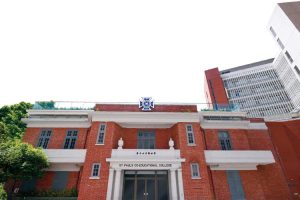
St. Paul’s Co-educational College takes first place because its 2026 results are strong across more than one academic pathway rather than because it produced the largest number of individual top scorers.
Its HKDSE cohort included five perfect scorers. Among 98 DSE students, the school recorded 137 Level 5** results and 409 results at Level 5 or above. It also reported that 92.9% of the cohort met the requirement for JUPAS degree courses.
The IB results add another dimension. The school’s latest 2026 update reports an average Diploma score of 43 out of 45, with seven students scoring the maximum 45. This makes SPCC particularly difficult to compare with a school operating only the HKDSE route: a meaningful HK secondary school ranking needs to recognise both programmes rather than look exclusively at DSE statistics.
For parents, the practical question is admissions. SPCC is a DSS school, so you should study its own current admissions route rather than assume that being in the same district means it operates exactly like a government or aided school.
2. Diocesan Girls’ School
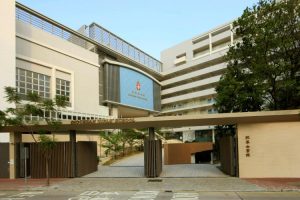
DGS remains one of Hong Kong’s strongest girls’ schools academically. Its 2026 DSE statistics provide unusually detailed evidence rather than only highlighting the highest-performing students.
Among 149 candidates and 944 subject entries, DGS recorded 132 Level 5** entries, 369 at Level 5* or above and 604 at Level 5 or above. That means 64.0% of the published subject entries reached Level 5 or higher. English Language was particularly strong, with 87.9% of candidates attaining Level 5 or above.
The school also offers a GCE A-Level route, giving senior students another academic pathway. For a family deciding between DGS and an equally selective DSE-only school, this curriculum flexibility may matter more than one or two places in a secondary school ranking.
3. Queen’s College
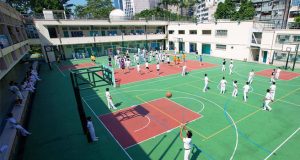
Queen’s College provides a different proposition because it is a government boys’ school rather than a DSS school.
It produced three DSE top scorers in 2026, including one super top scorer, the highest number this year among the government schools in this shortlist. The school also maintains a broad English-medium academic curriculum while Chinese Language and related subjects are taught in Chinese.
For families considering Queen’s College, ranking position must be combined with an understanding of the public-sector allocation and discretionary-place route. A very strong academic profile does not turn it into an independently admitting DSS school.
4. La Salle College
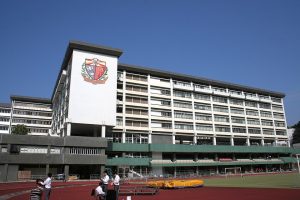
La Salle College is an aided boys’ school in Kowloon City and produced two of the city’s 2026 top scorers: one super top scorer and one top scorer.
The school’s own result announcement adds useful depth. Thirty-eight students scored 35 points or above in the 2026 HKDSE, which shows that the high-end performance was not restricted to two students.
La Salle is particularly relevant if you want a traditional aided-school route with a strong English-medium academic culture rather than a fee-charging DSS model.
5. Diocesan Boys’ School
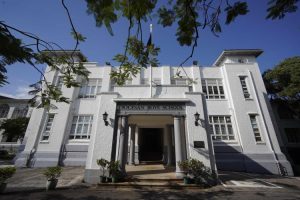
DBS illustrates why a ranking based only on 2026 DSE top-scorer counts would be too narrow.
The school operates a highly selective DSS admissions model and provides both an HKDSE curriculum and a dedicated International Baccalaureate Diploma route. Its academic environment is combined with unusually substantial music and sports programmes.
That breadth changes how you should evaluate the school. If your child is considering IB, high-level music or competitive sport alongside strong academics, DBS can remain a top personal choice even when another school has more DSE top scorers in one examination year.
6. Heep Yunn School
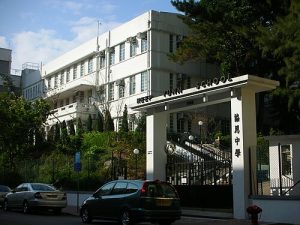
Heep Yunn is another Kowloon City DSS school and one of the strongest girls’ options in this 2026 shortlist.
The school produced a super top scorer in the 2026 HKDSE. Its senior curriculum is also notable because Forms 5–6 can access an International Advanced Level route alongside the wider senior-secondary programme.
This gives families another reason not to treat the hk secondary school ranking as simply a DSE table. If a student may later prefer an international qualification, the availability of that route can materially change school fit.
7. Pui Ching Middle School
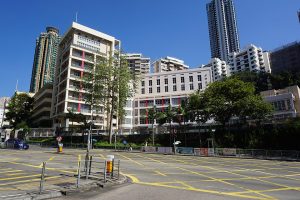
Pui Ching is one of the most useful schools in this ranking for challenging a common assumption: that every top academic school must use English as its principal medium across most subjects.
Pui Ching is an aided co-educational school whose main teaching language is Chinese, although English is used for English Language and English or bilingual resources appear in selected STEM subjects.
It nevertheless produced two 2026 DSE top scorers, including one super top scorer. That performance makes an important point for parents: medium of instruction should be matched to the learner, not used as a substitute for judging academic quality.
A student who processes complex concepts more effectively in Chinese may perform better at a strong CMI school than at an EMI school chosen mainly for status.
8. St. Paul’s College
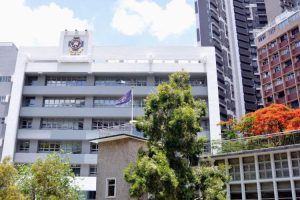
St. Paul’s College is a boys’ DSS school in Central & Western and produced a super top scorer in 2026.
Its current curriculum is also relevant to internationally minded families because senior forms offer both the HKDSE and International A-Level pathways.
That gives students more flexibility at the point when subject specialisation and overseas university planning become important. It also means that comparing SPC with an aided DSE-only school requires more than looking at one public-examination percentage.
9. King’s College
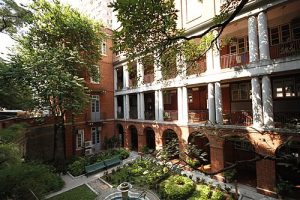
King’s College is another government boys’ school in Central & Western and produced a super top scorer in the 2026 HKDSE.
Its senior curriculum offers a broad range of English-medium subjects and includes both M1 and M2 Mathematics options. For students considering quantitative university routes, the availability of extended mathematics is worth checking rather than assuming that every secondary school provides identical combinations.
As with Queen’s College, admission feasibility is closely connected to its government-school status and the relevant Secondary School Places Allocation arrangements.
10. Ying Wa Girls’ School
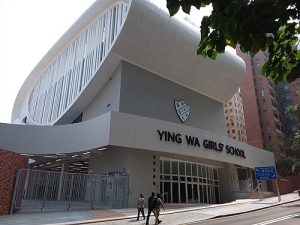
Ying Wa Girls’ School completes the Top 10. It is an aided girls’ school in Central & Western and produced a super top scorer in 2026.
The school maintains a broad English-medium academic offering across Mathematics, Sciences and Humanities, while Chinese Language and specified other subjects use Chinese.
It is a good reminder that families comparing Central & Western schools should not place every well-known school into the same admissions category. SPCC and St. Paul’s College are DSS schools; King’s College is government; Ying Wa Girls’ is aided. Their ranking positions may be close, but the route to a place is not identical.
Top Secondary Schools by District
District matters because Hong Kong’s school-choice system is not simply a city-wide marketplace where you rank every school and apply in the same way.
For government and aided schools participating in the Secondary School Places Allocation system, your school net and allocation strategy matter. DSS schools can operate different admissions mechanisms, and some schools recruit independently of the Central Allocation process.
| District | Schools to Research | 2026 Academic Signal | Why District Matters |
|---|---|---|---|
| Central & Western | St. Paul’s Co-educational College; St. Paul’s College; King’s College; Ying Wa Girls’ School; St. Joseph’s College; St. Stephen’s Girls’ College | SPCC had 5 DSE top scorers; St. Paul’s College, King’s College and Ying Wa Girls’ School each produced a super top scorer | Exceptionally deep mix of DSS, government and aided schools; admission route must be checked school by school |
| Wan Chai | Queen’s College; St. Paul’s Convent School; Wah Yan College Hong Kong; The True Light School of Hong Kong | Queen’s College produced 3 DSE top scorers; Wah Yan College Hong Kong also produced a top scorer | Strong government/aided choices make allocation strategy and school-net planning particularly relevant |
| Eastern | Belilios Public School; Cheung Chuk Shan College; St. Mark’s School | Long-established academically strong government and aided choices, including several English-medium routes | Useful Hong Kong Island alternatives to concentrating every application on Central & Western or Wan Chai |
| Kowloon City | Diocesan Boys’ School; La Salle College; Heep Yunn School; Pui Ching Middle School; Maryknoll Convent School | La Salle and Pui Ching each produced 2 DSE top scorers; Heep Yunn produced a super top scorer | One of the deepest academic districts, but school type and medium of instruction vary significantly |
| Yau Tsim Mong | Diocesan Girls’ School; St. Mary’s Canossian College; Queen Elizabeth School; Wah Yan College Kowloon | DGS produced 2 DSE top scorers; St. Mary’s Canossian College also produced a top scorer | Families should compare girls’, boys’ and co-ed choices separately and check SSPA participation |
| Sha Tin | S.K.H. Tsang Shiu Tim Secondary School; Shatin Tsung Tsin Secondary School | Shatin Tsung Tsin recorded its first DSE top scorer in 2026 | Strong district schools may provide better admission feasibility and a much shorter commute than cross-district prestige choices |
| Sai Kung | Po Leung Kuk Laws Foundation College; HKBU Affiliated School Wong Kam Fai Secondary and Primary School | Both recorded first top-scorer milestones in 2026; Laws Foundation produced a super top scorer | DSS applications and school-net choices need to be planned separately |
| North / Tuen Mun | HKTA Tang Hin Memorial Secondary School; Po Leung Kuk Tang Yuk Tien College | Tang Yuk Tien produced a DSE top scorer in 2026 | Local academic strength may provide a better combination of admission probability and daily travel than targeting only urban-core schools |
Source basis: current 2026 examination reporting, current school profiles and Education Bureau school-allocation information. This district table is a research shortlist, not a second overall ranking.
Central & Western stands out in 2026 because four schools in the district appear in this article’s overall Top 10. But that does not mean a child in another district should automatically commute across Hong Kong to attend school there.
Kowloon City is equally significant. DBS, La Salle, Heep Yunn and Pui Ching offer four quite different models: boys versus girls versus co-ed, DSS versus aided, and English versus predominantly Chinese medium. A family can therefore remain within one district and still face very different educational choices.
The 2026 DSE also produced notable milestones outside the traditional prestige-school clusters. Shatin Tsung Tsin Secondary School and HKBU Affiliated School Wong Kam Fai recorded first top scorers, while Po Leung Kuk Laws Foundation College produced its first super top scorer.
That is useful evidence for parents who assume that the top secondary schools in HK must all be concentrated on Hong Kong Island or in traditional Kowloon districts. Strong academic options exist across the territory, and a shorter commute can be a substantial advantage over six years of secondary education.
How Is the HK Secondary School Ranking Calculated?
This hk secondary school ranking uses an explicit editorial framework because there is no official Education Bureau score that can simply be copied into a table.
| Criterion | Editorial Weight | Evidence Considered | Why It Is Not Used Alone |
|---|---|---|---|
| Latest public-exam outcomes | 45% | 2026 HKDSE top scorers; Level 5** and Level 5+ distributions; IB or A-Level outcomes where schools run parallel pathways | One exceptional student or cohort can distort comparisons, and schools disclose results differently |
| University progression | 15% | JUPAS degree eligibility, university offers and destinations where comparable current evidence is available | Schools publish university information with very different levels of detail |
| Curriculum breadth and pathways | 15% | HKDSE subject range, M1/M2, IB, IAL/A-Level routes, languages and academic enrichment | Having more subjects does not automatically mean stronger teaching |
| Sustained academic track record and selectivity | 15% | Longer-term academic strength, competitive admissions and consistency beyond one examination year | Highly selective intake itself contributes to strong outcomes |
| Co-curricular and student-development breadth | 10% | STEM, languages, music, sport, leadership, service and wider development opportunities | Quality and child fit cannot be reduced to one objective number |
Source note: The percentages are HK Edu Journey’s editorial weighting for this article. They are not Education Bureau weights or an official school-rating formula.
Public examinations receive the largest weight at 45% because this is ultimately an academic secondary school comparison. However, the underlying measurement is broader than counting the number of top scorers.
SPCC shows why. Five top scorers are impressive, but the deeper evidence is that 98 DSE students collectively achieved 137 Level 5** results and 409 Level 5+ results, while a separate IB cohort reported an average of 43. DGS similarly provides a complete distribution across 944 DSE subject entries. Those figures tell you considerably more about cohort-level academic performance than one headline student.
The problem is that not every school publishes data at this level of detail. Some provide complete grade distributions. Others publish only top results, average points or university destinations. A ranking that pretends these datasets are perfectly standardised would be misleading.
University progression receives 15%. Examination grades matter partly because they open the next educational step. Where schools disclose reliable information about JUPAS eligibility, local university admission or overseas university offers, that evidence is considered.
Still, university destinations are not a pure measure of teaching. A selective school may admit pupils who were already performing at a very high level before Secondary 1. Family resources, subject preference and whether students apply locally or overseas also influence outcomes.
Curriculum breadth receives 15%. This has become increasingly important because several high-performing Hong Kong secondary schools do not operate one single qualification pathway.
SPCC and DBS have IB routes. DGS offers a GCE A-Level option. Heep Yunn and St. Paul’s College provide international senior-secondary choices alongside the local curriculum. For some families, that flexibility is a major advantage.
At DSE schools, breadth within the local curriculum matters too. Check whether M1 or M2 is available, which sciences can be combined, what language subjects are offered and whether your child’s preferred electives actually run every year.
Sustained strength and selectivity receive 15%. A school should not leap from number 30 to number 2 simply because one exceptional student became a top scorer in 2026. Conversely, a school with a long record of strong outcomes should not disappear from consideration because one cohort produced no headline “super top scorer”.
This is one reason DBS remains in the upper part of this ranking despite the 2026 top-scorer distribution being led by other schools.
Student-development breadth receives the final 10%. Secondary education occupies six formative years. Music, sport, STEM, leadership, service, debating, languages and other activities can shape confidence and university applications as well as school enjoyment.
This part of the methodology is deliberately weighted lower than examinations because extracurricular breadth is harder to compare objectively. A school listing 80 clubs is not automatically better than one with 40 strong programmes.
The methodology also deliberately avoids treating terms such as “Band 1A” as an official Education Bureau ranking. Parents frequently see those labels on education websites and discussion forums, but they should not be confused with an official EDB city-wide league table.
The more defensible approach is to use verifiable school information, current examination evidence and the actual admissions system, then state clearly where editorial judgement begins.
How to Use a Secondary School Ranking When Choosing a School?
The most useful way to use a secondary school ranking is to shorten a very large market into a manageable research list. The least useful way is to decide that number four is automatically a better school for your child than number seven.
Start with the following checks:
- Separate ranking from admission route. Identify whether each school is government, aided or DSS and whether it participates in the relevant SSPA process. In the 2026 allocation cycle, the Education Bureau continued to operate Discretionary Places and Central Allocation for participating schools, while schools outside those arrangements can require separate applications.
- Compare your child’s academic level with the school’s realistic intake. A famous school does not become a sensible choice simply because it ranks highly. Look at school reports, internal assessment, allocation band information available through your primary school and the school’s own admissions requirements.
- Check medium of instruction carefully. EMI is not automatically better for every student. Pui Ching’s 2026 results demonstrate that a predominantly Chinese-medium school can achieve elite academic outcomes. Ask where your child actually understands difficult concepts most effectively.
- Check curriculum before reputation. If your child may want IB, International A Levels or another senior route, a school that provides that option can be more useful than a higher-ranked DSE-only school.
- Look at individual subject strength. A general high ranking does not tell you whether the school is particularly strong in Mathematics, Sciences, languages, humanities, music or sport. Your child’s likely strengths should affect the shortlist.
- Do not ignore gender and school culture. Hong Kong’s top academic schools include boys’, girls’ and co-educational schools. A child may respond very differently to each environment.
- Calculate DSS fees where relevant. Government and aided schools follow a different financial model from fee-charging DSS schools. If several children may attend fee-charging schools, calculate the six-year family cost rather than comparing only academic prestige.
- Test the commute. A student travelling 55 minutes each way spends more than nine hours a week commuting over five school days. Over six years, that is not a minor detail. Strong district schools can provide more sleep, activity time and independent study than a prestigious cross-harbour choice.
- Read the current school profile, not an old forum post. Subject combinations, medium of instruction, class structure and admissions policies can change. Use the current Secondary School Profiles and the school’s own website as your baseline.
- Treat interviews as part of school fit. Selective DSS admissions can consider academics, extracurricular achievements and interviews in very different proportions. A student with excellent examination results but weak communication should prepare differently from a strong all-rounder.
- Build three levels of shortlist. Keep aspirational choices, realistic matches and practical alternatives. Every school on the list should still be one you would genuinely accept.

District strategy deserves particular attention if you are entering the Secondary School Places Allocation process.
The Education Bureau’s 2026 cycle included Discretionary Places applications at the beginning of the year, followed by the Central Allocation process and release of allocation results in July. That system means the decision is partly about where and how you apply, not simply which school has the highest position in an online hk secondary school ranking.
A government school such as Queen’s College and a DSS school such as SPCC may both appear near the top academically, yet they should not occupy identical boxes in your admissions plan.
The same principle applies inside Kowloon City. La Salle is an aided school, DBS and Heep Yunn are DSS schools, while Pui Ching is aided and mainly Chinese-medium. Ranking all four without noting those differences gives parents much less useful information than the names initially suggest.
You should also avoid overreacting to one year’s examination news.
The 2026 HKDSE produced first top scorers at schools including Shatin Tsung Tsin Secondary School and HKBU Affiliated School Wong Kam Fai, while Po Leung Kuk Laws Foundation College celebrated its first super top scorer. Those are meaningful achievements and reasons to investigate the schools more closely. They are not, by themselves, proof that every family should suddenly rank those schools above institutions with a longer record of strong cohort-level results.
The reverse is equally important. If a historically strong school has no top scorer in 2026, that does not mean its teaching quality suddenly collapsed. Look at several indicators.
For practical school visits, I would ask questions that a league table cannot answer:
- What proportion of students take M1 or M2?
- Which elective combinations were actually available to the current senior cohort?
- How does the school support students who fall behind?
- How many students move between academic streams?
- What is the English and Chinese language environment outside lessons?
- How much homework is typical in junior forms?
- Are activities accessible to ordinary students or concentrated among elite performers?
- How are new S1 students supported during the transition from primary school?
- What happens if a student wants to change an elective?
- How does the school advise students considering local versus overseas universities?
You may find that the school ranked number eight answers those questions in a way that suits your child much better than the school ranked number two.
That is not a failure of the ranking. It is exactly how a ranking should be used.
The purpose of a Hong Kong secondary school ranking is to identify schools worth investigating. The final choice should come from academic fit, admissions feasibility, curriculum, language, school culture, location and your child’s own response to the environment.
References
- Committee on Home-School Co-operation — Secondary School Profiles. Current school-verified information used for district, school type, gender, curriculum and medium of instruction. https://www.chsc.hk/ssp2025/index.php?lang_id=1
- Hong Kong Education Bureau — Secondary School Places Allocation. Official information on the 2026 S1 allocation cycle, Discretionary Places and Central Allocation framework. https://www.edb.gov.hk/en/edu-system/primary-secondary/spa-systems/secondary-spa/general-info/index.html
- Hong Kong Examinations and Assessment Authority — HKDSE. Official information and 2026 examination-results context. https://www.hkeaa.edu.hk/en/HKDSE/
- St. Paul’s Co-educational College — Public Exams. Detailed 2026 HKDSE and IB results, including cohort size, Level 5** distribution, Level 5+ results and IB Diploma performance. https://www.spcc.edu.hk/academic/culture-of-excellence/public-exams
- Diocesan Girls’ School — Achievements. Detailed 2026 HKDSE result distribution covering 149 candidates and 944 subject entries. https://www.dgs.edu.hk/school-profile/83-dgs/achievements
- La Salle College — Result Announcement of DSE 2026. School-published information on its 2026 top scorers and high-scoring cohort. https://www.lasalle.edu.hk/community/news/result-announcement-of-dse-2026/
- The Standard — Record 24 Students from 15 Schools Crowned Top Scorers in HKDSE. Used to cross-check the 2026 distribution of top and super top scorers across Hong Kong schools. https://www.thestandard.com.hk/news/article/337275/Record-24-students-from-15-schools-crowned-top-scorers-in-HKDSE
Disclaimer
The content of this article reflects the author’s personal views and is provided for informational purposes only. It should not be regarded as professional investment, medical, legal, employment, or other specialist advice. Some information in this article is sourced from publicly available online materials. If any content is found to infringe copyright, please contact the website administrator for prompt removal or correction.
Readers are solely responsible for any actions taken based on the information provided in this article. The website accepts no legal liability for any risks, losses, or damages arising from such actions.
For more details, please see the Disclaimer.